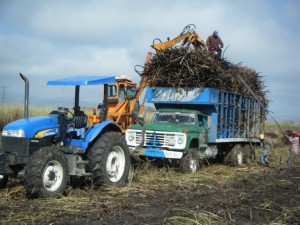
The last of the sugarcane being lashed down in order to be hauled off the field in the mud
This blog is going to be a bit different than most because I have a personal bone stuck sideways in my craw. I need to vent some bile, as it were, and get this thing off my chest. But then, maybe it is just because I am a tired old man tonight, and not a little crotchety at the moment. But, at any rate, bear with me on this one please.
I will set the whole “sideways in the gizzard thing” into perspective by saying that we finished our harvest on Saturday morning, watching as the last load of sugarcane was loaded and hauled off the field. On Monday morning Javier and I began the brutal post-harvest work of pulling the cut off tops of the cane into rows for burning, and cutting the several inches of stock remaining sticking out of the ground down to the top of the root ball. We had a heavy rain on Sunday evening that lasted throughout the night. The conditions in the field were pretty nasty yesterday. Last night we had even heavier rain throughout the night, and now a steady drizzle all day. We were wading around with 25 pounds of sticky muck on the bottom of our boots today as we continued to clean the field. But, today we did have three guys working with us that we hired to help. We still have several more days of brutal labor before we are finished with this part of the job.
So, to put it into perspective for you let’s create an image that is easier for you to imagine.
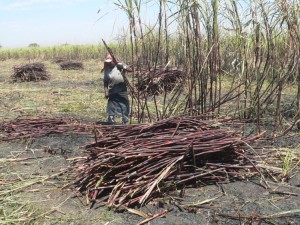
This is an agarron of sugarcane – a laborer’s pile of cut cane. He will be paid by the amount of cane that he will cut
Let’s suppose that you have a field of 13 ½ acres in which you were growing corn. But this corn is a little different than normal in that it is a perennial, and it is actually the stock that you want to harvest. So, from there on the similarities are actually quite striking. Sugarcane is not dissimilar from corn, either in the stock itself, or in the height that it grows.
To begin your harvest you burn the field in order to eliminate the dead leaves that are chocking the bottom ¾ of the stock, leaving only the green top of the plant on the singed stock.
Next, you have 20 – 50 men congregate on your field to cut the corn stocks, leaving the topmost, green 3 – 4 feet of tip in rows in your field. The stocks are all placed into piles, each worker being paid for his own piles of “corn” which he has cut from “his own rows”. (More about this later – this is part of the “crosswise bit”).
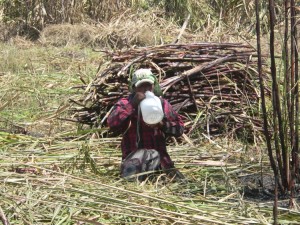
A cutter takes a water break beside his pile of sugarcane
Now, the piles are all loaded onto trucks and hauled off of the field. Voila, harvest is done for another year!
Or is it?
Now, the real work (for us) begins. The cutting, piling, hauling, and actual harvest sweating was done by other men, not by us. Now, however, the post-harvest work falls onto us.
Remembering our hypothetical perennial corn harvest again – as soon as the crop is off of the field you will need to pull all of the tops into rows so that they can be burned. The problem with them is that they are very course and durable, and since there will be very little moisture over the next months they will not break down. Also, if they are left on the field they will become a breeding ground for rats and other rodents that will eat your sugarcane. So, despite the loss of organic matter, the best solution is to burn them.
But, since your crop is perennial, sending multiple new baby shoots out from the root ball,
The sugarcane tops are placed into rows
you need to cut down each stub of stock that is still left after the crop has been cut off. These need to be cut down as close to the ground (the root ball) as possible. This also needs to be done posthaste because in a matter of only days the tender shoots are already forming out of the roots. If one dilly dallys around before you cut the stock stubs down, or before burning the tops you will destroy the new, tender growth, and hence next year’s crop.
Okay, the thing is, remember our 13 ½ acre field? All of this work has to be done by hand with a crooked stick, bent back, and a machete. The stick is to pull the tops into rows for burning, and the machete to hack each stock-end back to the root ball. After a half hour of this work your lower back starts to talk to you, after two you can’t straighten up any more. After about three your hand “freezes” onto the stick and you can’t open your fingers any more. Thirteen plus acres may not seem like much until one works every inch of it with a bent-over back.
Okay, so, there is my little word picture. I am not telling you this so that you can pull out your violins and give me a pity party, or so that I can look like a hero. That is not the reason. Rather, herein is “my bee in the bonnet”…
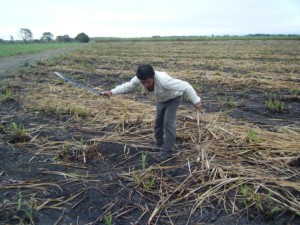
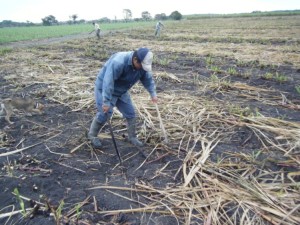
A field worker cuts sugarcane stock down. Note the machete in one hand and the crooked stick in the other. These are our tools of the trade
I find it very difficult to deal with people telling me “how cheap it is in Mexico” (quote unquote). Let me explain what I mean:
First of all, it is not cheap to live in Mexico. It may have been at one time, but so was Canada. During the depression my grandfather worked for 25¢ per hour, or per day, or some such thing. But that was a long time ago. Certainly, no one would consider Canada to be a cheap place to live now. Besides perhaps a head of broccoli or some such locally grown veggie, nothing is cheap here, and I challenge anyone to find much of anything that I cannot buy cheaper in the States than I can buy here. Any manufactured product is much more expensive here than in the States. Gas is now close to $1.10 dollars per liter ($4.10 per gallon). I don’t know how much diesel fuel is, but the cost of everything is reflected in the ever-increasing cost of fuel.
Okay, okay – gripe, gripe! But I do have a point in all of this. This is my point:
For many men in our area the harvest is the main income for much of their year. They are paid by the amount of sugarcane that they cut. They receive $14 pesos per “agarron” (the piles of cut cane) from the sugarcane mill – their employer. The farmer whose field they are harvesting must make up the rest. This year the harvest laborers are receiving $20 pesos per agarron (ie., the farmer pays the difference between the $14 pesos and the $20). Each pile (the agarron) weighs approximately ½ ton. Depending upon the conditions of the field, the sugarcane, the skill and experience of the cutter, the thickness of the rows, and many other factors, a good harvester can cut somewhere between 6 to 10 piles per day – that is to say, somewhere from three to five tons of sugarcane per day. This is all cut with a machete, and then hauled onto piles by hand.
At the end of the day that laborer has made somewhere between $120 pesos to $200
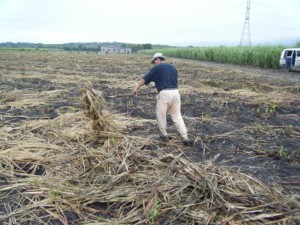
Javier working on placing the tops into rows. Note the Casa del Obrero house in the background
pesos for the day of backbreaking labor. So, what does that mean in currency that is more recognizable to North Americans? Well, in U.S. dollars the exchange now is somewhere around 12 to the dollar. That means that our worker has made around $10.00 to $16.65 per day depending upon his skills and the luck of the field that he is cutting.
Oh, and have I mentioned that we routinely have temperatures that run in the triple digits, dropping down into double digits only at night, simply to soar again as soon as the sun breaks the horizon? Did I mention that last summer we officially reached 57° C (134.6 ° F)? True, that was a bit of an exception from the norm, but not so unusual as to make much more than an item for casual conversation for several days.
Then, let’s take the guys that Javier and I worked beside in the mud today. We are paying them a fair wage; the going rate, and perhaps even on the top end of the going rate for field laborers – $120 pesos per day (in U.S. dollars this is about $10.00). Remember, this is per day of field labor. But one must pay within the wage scale of the norm or else you end up not helping in the end, but only building an unattainable expectation in the workers. If we were to pay an unreasonably high wage to our laborers, then that person would not be happy to work within the wage scale of the country. Although it may sound big hearted, in the end it would do more damage than the short-term good that one had tried to accomplish.
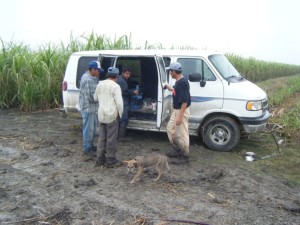
Our lunch in the rain. Even Pancho looks like a drowned rat today
So, back to my shtick – please don’t tell me that living in Mexico is so cheap. It certainly is not! Again, almost anything that I can buy here in Mexico I can buy cheaper in the States, with some things being much cheaper there. Please don’t patronize my friends and say “Well, they are happy and don’t know any better.” That questionably may have been true 100 years ago when people had little exposure, but I doubt that it was even the case then. There have always been class differences, and people have always desired to improve their own lot in life, and that of their children. Don’t tell me that it is just cheaper for them to live because they expect so much less. Of course it is! It would be for the typical North American as well if they would eat only beans and tortillas and an occasional egg or two when they could afford the extra cost of buying them. It isn’t because the poor like to eat only cactus and tortillas that they do so, it is because that is all that one can buy on an income of $10 dollars per day where that money buys the same as your $10 dollars does.
So there, my bile is spilled, my chest has the weight removed from it, and I have spoken my mind. But let me add this little bit to the end, (just to be redundant I am sure). I am afraid that too often we as North Americans forget the incredible gift that God has given us by being born where we were. Certainly Mexico is not the poorest nation in the world, and is not even close to being so. There are many places where the economic conditions are much, much worse than here. But it is here that I live, and it is here that I see my friends and fellow workers. It is here that I see the unfair conditions under which they must live.
Whenever we complain about how hard done we are, and how unjust our state in life is, we need to get out heads out of our little, tiny, privileged bubble and see how so much of the real world lives every day. And I don’t mean from the window of our $200 dollar per night Hilton either, or from the back seat on a $50 dollar taxi ride from our luxury time-share resort so that we can see where the natives live. I mean the real world where billions of people struggle each day to feed their families and simply to survive one more day.
Too many hours working in the rain and mud for an old, tired man? Maybe.
But, maybe God also wishes to wake us all up a little as well. Are we trying to keep up with
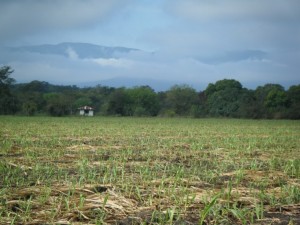
The mountains to the west of us in a low cloud cover
the Jones’? Have we become complacent and self centered? Are we taking our petty little preferences and demands too seriously? Do we need to get a bigger picture of the real world?
In a more enlightening way, and spoken better by a much more knowledgeable man, I would refer you to K.P. Yohannan, the founder and president of Gospel for Asia. His book “The Road to Reality” is a must-read. Also, by going onto the Gospel for Asia website (http://gospelforasia.org) and then scrolling down to “free resources for you” you can download many of his soul-searching messages free of charge. He, unlike me, is much gentler in his approach, but nonetheless, no less to the point. That point is not Guilt, but rather Reality.
God, open my eyes please to the reality of the real world. May your Kingdom come. May it come soon!
Your weary and sore friend,
Steven