• About VitW
    • Background
    • Beginnings
    • Work Continues
    • VITW Today
    • VitW Vision
  • VitW Blog
  • Bible School Ministry
  • Archived Letters
  • Support / Donate
  • Contact VITW
  • Prison Experience
Follow VitW on Twitter!

Current Events and Updates of the Ministry

Subscribe to VitW Ministries Blog by Email

10

Dec

We need your help please.

Written by Steven Frey

Javier Santos' Mission Outpost in Buenos Aires. The pole structure behind the building is where they hold a feeding program for the village children.

I ended up my last blog with the following words, “I feel that we are at the threshold of moving forward with the Training School. New things are in the wind. I believe that we will soon have students living, working, and training on the farm. God will soon bring into reality the vision and dream. But we must think big and not give up or loose faith”.

We are at the threshold, but not without opposition.

We have an enemy who is not pleased with the forward advance of God’s Kingdom. We cannot quit or give up (or give in).

This blog will not be comfortable in its writing, nor in its receiving, but unfortunately it must be written. Theresa and I discussed its timing, and unfortunately I know that December, just before Christmas is not good financial timing for anyone, but then, when is?

So, here goes…

I have become very aware over the past months that we must make some drastic changes in the way that we have structured the work, specifically how it relates to Javier Santos. As you are aware if you have been reading the blogs, Javier, as farm administrator, is my right-hand man. He has taken on an incredible amount of work and responsibility with little or no thanks, and pitifully little financial remuneration for doing it. In fact, since we were starting on a shoestring and a song we had to ask him to wait for any payment for his services until after payment for the first harvest. This request was made in February of 2011 when we asked him to take on the responsibility. At that time I really had no idea how much work would actually be involved for him, how long it would take to be reimbursed for the following year’s harvest, and besides we simply didn’t seem to have options. Javier agreed, knowing full well the amount of work that he was taking on his shoulders, and doing so for the love that he has for God, and the desire that he has to see men and women trained as godly disciples and in God’s Word.

Over the past year and a half I have become painfully aware of all that we have asked of him. He has graciously shouldered the load and has stated to me many times that he is not doing it for man, but for God.

We have now taken off our first harvest, but to my chagrin we apparently will not be receiving full payment on the sugarcane until into June or July of 2013. Obviously paying Javier will take priority, but we may not have enough in the first partial payout in February to take care of our debt to him. This will mean that Javier will have worked for over two years before receiving payment for his work as farm manager. To make this matter even more unconscionable, in the process of devoting his time and attention to working on the Training Center farm he has had to devote less time, or do double time in other work that he is called to do – pastor a church, run missions, work his own farm, be father of three boys and husband to Cristina etc.

I feel that we must make a radical change in this demand on him in the new year. One way that we can do this is to pay someone to do the day-to-day work of running the farm, thus taking the daily load off of Javier’s shoulders. Javier would continue to be the farm manager and the director of the Training Center, but the daily work load would be relieved to a large extent and he could focus more on overseeing rather than on the physical work involved in the farm.

We already have someone in mind, but I have not spoken to him as yet until I can be assured that we have the finances to pay him. This is a godly couple that we believe would fit well into the work of running and maintaining the farming end, and more importantly maybe, who could also perhaps grow into the role of being the teaching/mentoring couple who would live on the farm with the students.

In order to be able to take him on as a fulltime employee we need to be able to commit $50.00 per week. This means that if four people would commit to $50.00 per month we could take on a fulltime worker who could both relieve the pressure from Javier and also be trained into the role of becoming mentor and teacher at the Training Center.

My prayer though, is that this specific generosity world not diminishes other giving. We so desperately need finances to commence building the housing needed to begin the Training Center. We trust the Lord for this provision, but we must begin soon. Until we can build a place to house a couple and students we cannot advance with the vision. Because of this I request that we are able to designate any funds that come in over and above the needs for staffing to be used for building.

Please prayerfully consider helping us in this.

For U.S. supporters it is very simple to send money and to receive a tax receipt for your donations. All funding for this specific need, over and above your normal giving, should simply be sent to the normal address at Grove, Oklahoma, but marked as “PERSONNEL” in the Note are of the check. Again, I ask that any amount that is received that is not needed for the paying of staff can be utilized for the beginning of building the Training Center housing.

For Canadian supporters – there is a small complication with Canadian charity laws and giving for this specific need (over and above your normal giving for the ministry as you have been doing), cannot be tax receipted through the normal channels. Gifts can also be sent to the normal address at Listowel, Ontario, and marked as “PERSONNEL” in the Note are of the cheque. Again, I ask that any amount that is received that is not needed for the paying of staff can be utilized for the beginning of building the Training Center housing. However, unfortunately these specifically designated gifts cannot be tax receipted in Canada.

If you have any questions at all concerning these needs, the reasons, where to send the donations, etc., please do not hesitate to email me at steven@vitwministries.com. You can also call me at (702) 516-1478. This is a U.S. MagicJack number and it is billed as a U.S. call.

I trust that you are having a wonderful December as you get ready for Christmas. May the season and the great gift of our Saviour fill you with joy.

Your missionaries,

Steven and Theresa


Posted in VitW Blog | No Comments »


26

Nov

Two Strikes and You Are Out? or, “Oh You of Little Faith?

Written by Steven Frey

Early morning harvest in foggy field

Well, the sugarcane saga continues. I kind of left you at the cliff-hanger with my last blog, and I must now give you the “rest of the story”.

The last entry ended on Sunday with mud up to our eyeballs and one more day to get the cane off of the field. Monday arrived with sunshine and hope. We did need to hire a tractor to pull each loaded truck off of the field, but the complete burned portion was removed with a harvest that surpassed the estimated amount.

The harvested portion of the field was a terrible mess from the heavily loaded trucks and the tractor having gouged great furrows through the rows of cane roots. To make matters even more difficult, since the green tops of the cane do not burn when the field is burned for harvesting, when the harvesters cut off the cane tops they are piled into windrows. In a dry field the trucks can drive over them without incident, and they can all be gathered later and are usually burned. Since our field was absolute muck when the trucks were driving around on it, our tips were ground into several inches of clay gumbo and will all have to be pulled out of the heavy mess and stacked for burning.

I had hoped to see if we could use the cane tops for silage. However, since we have nothing prepared for this at this

Lighting cane fire in field

point we decided to see if we could simply chip it back into the field as a green manure mulch. The fact that they were ground into the mud made this plan seem farfetched for this particular harvest, but we thought that we would give it a whirl anyway to see if it might be possible for future harvests.

On Tuesday I began to collect the tips into piles. On Wednesday we got the wood chipper out and gave it a whirl. We found out that although the chipper was not designed for this purpose, it was possible to chip the sugarcane tips – but with a lot of work and time. We did several rows and were getting ready to put the equipment away and go home for the night when a young man stopped by the field and told us that the engineer had ordered the last portion of the field burned.

It had been dry since Monday and things were beginning to dry out and look hopeful for the remaining part of the harvest. I had been hoping that the engineer would wait for a couple more days before ordering the last burn to give it even more time, but still, things should go okay with the current conditions.

Field ablaze

The field was torched, and an impressive conflagration it was indeed. This was the first time that I had seen an actual burn up-close-and-personal, and it is an awe-inspiring sight to be working beside it as it goes along the field.

We returned home on Wednesday night tired, very dirty, and hopeful that there would be an easy harvest on the following day.

At 1:00 o’clock in the morning I woke up to the sound of a steady downpour. I tossed and turned until the alarm clock went off at 6:00 o’clock, always with one ear on the unceasing rain which had lasted throughout the whole night.

When Javier arrived we resignedly loaded the van and headed out to the field to see what the damages were. Once again, we could barely slip our way to the farm – the main roadway was almost impassable – worse, if that is possible, than last week.

But the cane cutters were in the field – actually two crews – and the cutting had begun. With the very wet field we did not expect that any trucks would be moving. However, sometime midmorning we were told that we needed to get a tractor immediately because the trucks were going to begin arriving in order to remove what had been cut. More rain was expected, and the field would only get wetter than it was now if this were to happen.

Javier and I scrambled to find a tractor capable of the job ahead, and it arrived at the field just behind the first of the

The conditions were not great

trucks. The job of cane removal began.

Trucks continued to load all day – each one being dragged with spinning wheels and flying mud to the edge of the muck-filled field, and onto the sloppy roadway. From there they ground their way towards Cd. Valles, and the sugarcane processing plant.

Friday morning arrived without the expected rain overnight, but with a pea soup fog. Miraculously we did not receive rain all day and the last of the cutting was accomplished, and the very last of the trucks were hauled out of the field in the late afternoon.

The “Oh you of little faith” part is in reference to a fully-completed and very successful harvest despite some big setbacks. We did indeed need to hire a tractor for the three days of actual hauling. This is money that will have to come out of the profits for this year’s production. However, our tonnage exceeded the estimate by about 115 tons. It was estimated that we would take out about 306 tons. In actuality we removed approximately 420 tons of sugarcane – 26 loaded trucks.

Praise the Lord. This is the culmination of almost a year and a half of an incredible amount of work.

Loaded truck being pulled from field with tractor

So, that is the saga of the sugarcane harvest, 2012. If you go to the top of the blog page you will see a very large red button with the words “New Photos Section”. There you will find some cool harvest shots under the heading “Harvest 2012”.

But life here is not only sugarcane and harvest (although that is what has absorbed much of my time of late). Theresa is one going concern with her sewing classes. She seems to be acquiring more and more students almost daily. Our house is filled with buzzing sewing machines and chattering women from shortly after I leave for the field in the morning to long after I return at night (thank God for an “office” that I can sequester myself into until all of the female chatter ends in the evening).

Theresa is working on an idea with Cristina, Javier’s wife, where they will use the sewing machines in order to begin a little cottage industry in one of the very poor colonias where Javier and Cristina are pastoring a little village church. Right now it seems as if the idea might be to teach some of the local women how to make little animal-shaped purses and bags. These could then be sold, and the women would begin to have an income from something other than extremely back-breaking manual labour. I will try to keep you posted as this dream moves from vision to reality. It looks like the projected start-date is in the new year.

At the risk of making this blog entry too long, I also want to speak again about the vision for the Training Center on the

The very last load from the harvest, 2012

property. Our goal and purpose is not simply to grow sugarcane or have a self-financing farm. That is a very short-sighted goal. Rather, our dream is to create a place where men and women can live and work, study God’s Word, and learn to walk out in a practical way the Kingdom of God.

There is a lot of bad religious teaching floating around Mexico – stinking thinking – which teaches that truly godly people, a person who really trusts and loves God will not work at a “secular” job, but rather will “live by faith”. I have never figured out how the very ones who are the biggest proponents of this bad doctrine are also the ones most happy to mooch off of the very ones who hold the “secular” jobs. Still, the logic seems to follow the line of a conversation that I was told about yesterday. One of the brothers was asked to come aboard a certain church organization into leadership, and in so doing to give up his “secular” work and to “live by faith”. When he explained that he was currently running a music school which was his bread and butter, but the purpose of which was also to raise up men and women who could be worshipers, he was confronted by “Oh no brother, you cannot try to help God, you simply need to learn to live by faith”. To earn a living by holding a job was considered to be a sign of lack of faith in God’s provision.

If we can do nothing else at the Training Center, then I think that we have made great leaps forward if we can simply begin to break the hold that this false teaching has. If men and women can learn that God is as honoured, and that the Kingdom of God is as real, and that every action is as sacred whether one is preaching, teaching, weeding sugarcane, or slopping the hogs, then we have made great leaps forward.

Clearing cane tops into burning piles

We have also had some potentially wonderful news in our search for some way to begin with the much-needed housing on the land for the Training Center. I hesitate to say too much at this point because I still have not seen the final numbers on any of the ideas that I will put forward here. But, about a week ago a Christian brother and local businessman expressed his desire to help us at the Center with providing housing at his cost. One of the businesses that he has is constructing schools and houses for the government in the mountainous area to the south and west of us. The designs that they use are very simplified and basic, and the construction costs reflect this. There are some drawbacks to the construction since they can never have a second story added because the foundation and walls are only designed for a light load. However, any disadvantages are far outweighed by the much-reduced cost of the finished product. If the prices that I understood are correct, then perhaps God has opened up a way where individual churches can take on the cost of a building for the Training Center. I will also write more about this later when I can do so knowledgably, and not chattering on with only half-information.

I feel that we are at the threshold of moving forward with the Training School. New things are in the wind. I believe that

Theresa with newest sewing class student

we will soon have students living, working, and training on the farm. God will soon bring into reality the vision and dream. But we must think big and not give up or loose faith.

We need your continued love, prayers, and support.

Be blessed in God’s goodness.

With our love,

Steven and Theresa


Posted in VitW Blog | No Comments »


18

Nov

You Win a Few, Loose a Few, and a Few Get Rained Out!

Written by Steven Frey

And some get rained out

I am beginning to experience the life of a farmer first hand. I am seeing things that I never understood before. For example, how is it that you pray for months for rain, and then directly during harvest when you cannot use the rain you get a deluge? I am learning that you cannot control the weather or the outcome of your labour. But I am also learning that God is still in control despite what it may look like around you.

So, starting off at the beginning: in the October 29th blog I wrote that Theresa and I had not been able to bring our newly purchased disc and boxblade into Mexico when we crossed in the beginning of October. I also mentioned that I expected that our harvest would begin any day around the beginning part of November and we felt that we would need to wait until the harvest was over to go north again to attempt a second time to bring the equipment across. Sugarcane harvest is completely controlled by both the sugarcane processing plant and the cane syndicate, and the individual grower has no say in the actual time of the harvesting. When word is received that the process will begin on your field you must be ready and at their beck and call at a moments notice.

Around the first part of November we got word that our harvest would not begin until later on in the month, possibly not until the latter part of November or into December. At that point Javier and I decided to make a quick trip north to see if we could bring the much-needed equipment across with the help of Rafael Dueñas, the brother in Laredo who had made it possible to cross with the tractor and equipment earlier this year.

On Saturday morning (November 10th), we got an early start and headed north. Javier got out at Cd. Victoria (about

Sugarcane cutter with machete in hand

half way to the border) and we loaded him onto a bus for Monterrey. Since my return trip from Laredo would take me further west than normal and directly through Monterrey, his intention was to spend the time that I was in the States with some pastors in the Monterrey area that he has worked with over the years. We would then meet up at Berea Bible Institute just outside of Monterrey when I returned south. It was at Berea that we hoped to talk to a young couple that we felt might be perfect for the role of leader-couple for the Training and Discipleship Center on the farm.

After dropping off Javier I headed directly north to the U.S. border and crossed over to Donna where I spent the night with good friends of ours. The loaded trailer was being stored at their place, so on Sunday morning I hooked up the load and headed west to Laredo.

On Monday morning when I got to the office and warehouse I found that Rafael had not yet returned from Mexico City. However, I began the import process with one of the young men from his office that had been very instrumental in the crossing of the tractor earlier in the year.

Days of waiting for paperwork to be completed dragged on, and by Wednesday night I got word from Rafael that it might be best if I headed back to Cd. Valles and returned to Laredo later when the import process was finished. The hitch was with obtaining the proper permits from SAGARPA, the acronym for Secretaría de Agricultura, Ganadería, Desarrollo Rural, Pesca y Alimentación (Ministry of Agriculture, Livestock, Rural Development, Fisheries and Food). It was a purely bureaucratically tangled web, but since the equipment was used in another country all kinds of hoops needed to be jumped through in order to import it into Mexico.

Stack of cane ready for loading onto truck

On Thursday midmorning I got word that the wait might very likely be another two weeks or more. At that point I knew that I was skunked once again by Mexican bureaucracy, and I decided to head back to Monterrey to pick up Javier. The saga of the disc would continue later.

Javier and I spent a profitable time together at Berea Bible Institute on Thursday night. However, during our time there it became evident that the couple that we had hoped might be the ones for the work here in Cd. Valles were already functioning within their calling at Berea. They were very much plugged-into the work at Berea, and it was obvious that God had placed them there. It was a joy to see them working and functioning within their callings. Nonetheless, it was with a little bit of sadness that we realized that this was not yet the couple that God has for us for the work at the Discipleship Center.

On Friday morning we got a call from Cd. Valles to tell us that the burning was to begin on half of our land that very day, and that the harvest on it would commence on Saturday. We headed south through rain, wondering if indeed the harvest would take place if the weather continued as it was.

On Friday night when Javier and I arrived home to Cd. Valles we made an immediate trip over to the field, hoping

Stacks of cut cane ready for loading if the field dries out enough

against all hope that the message that we had received was wrong, and that the burn had not yet taken place. We had arrived to the city to find huge puddles of water and mud everywhere indicating that the rain had obviously continued unabated here in the Cd. Valles area over the last several days.

The harvesting process for sugarcane is that the field is burned, usually the night before the harvest is to begin. When the burn takes place the clock begins to tick, and within 72 hours the crop must be taken off and be delivered to the processor or else the cane will drop in sugar content. It also begins to develop a fungus. both of these make the value of the crop diminish drastically.

We slipped and slid our way down the muddy road to the field and upon arriving found that the report was true – half of our crop, about two and a half hectares had been burned.

Our clock had begun ticking!

I am rather unclear even yet as to who made the actual decision to begin the harvest process during this inclement weather that we are having now. It seems though that it was made by the engineer from the cane processors. They, of course, are under pressure to continue receiving cane for processing. We certainly were next on the list. Apparently the decision was made on Friday morning when it was not raining and there was hope that things might continue to dry up. Nonetheless, Mexico does have weather forecasts as well, and a simple check would have indicated the probability for continued rain.

It rained continuously Friday night. Cutting began Saturday morning during a steady drizzle all day. The road into the farm is almost impassable due to mud. Entry into the field will be 100% impossible.

Today is Sunday. Tomorrow is 72 hours and D-Day.

Rows of cane piles - cane tips laying between piles ( I want to experiment to see if we can make silage from these)

The good news seems to be (as I am trying to understand the system) that since our sugarcane is contracted to the processors, and since it was their decision to initiate harvest it is also their responsibility to ensure that the crop is taken off and delivered to their plant on time. If they do not fulfill this obligation of the contract they will still have pay us for our crop (at their estimated value). That seems to be the good news (within my limited understanding). The other good news is that the actual work of harvesting is all taken care of by crews of harvesters under the direction of the processors, and none of this falls onto our shoulders. Of course, everything, down to the last of the files used for sharpening the machetes in cutting the cane is deducted from the actual payment for our sugarcane. And the cane processors are certainly not in the business of charity – we will pay for every service (or supposed service) that they provide.

The bad news though, seems to be that there are probably two options at this point for getting the cane off of the field and to a place where the trucks can get it. Depending upon the condition of the field, we may need to hire a tractor to pull each loaded truck off of the field and onto an area of the roadway where they will be able to drive. Alternately, depending upon the amount of mud and the condition of the field, all of the cane may need to be hauled on human backs to the edge of the field to where the trucks will be able to access it. We are talking literally about tons and tons of sugarcane. This would be no small feat, and I can’t even imagine how much time and effort it would take. However, apparently this is not our worry. What is our worry though is that we will need to pay for the tractor if we need it to drag the loaded trucks out of the field. This will be a financial bite that we were not expecting, and will take a piece out of the income that we were so looking forward to in order to begin paying back the debts that we have accumulated over the past year in beginning the farm.

Still, as Habakkuk 2:20 says “The LORD is in his holy temple; let all the earth be silent before him”. We have nothing to fear. God is still on his throne in his holy temple. In my times of frustration and worry over this whole confusion of harvest – as I keep looking at the dark skies and the continuously falling rain – I keep reminding myself that this is God’s work, God’s crop, God’s harvest, and God’s Training Center that we are attempting to build.  And he is the one, and he alone, who controls the weather and the rain. We have done everything that we have known to do on our part. The rest is completely up to God.

This morning it is not raining, but it continues overcast and cool. The long-range forecast is for cloudy and partly cloudy for the week with storms again on Thursday.

God is still in his holy temple. He is in control.

With our love,

Steven and Theresa Frey


Posted in VitW Blog | No Comments »


8

Nov

Como los Antepasados – Like the Ancestors

Written by Steven Frey

Javier, Cristina and boys - heroes of the faith

Today Javier and I took a break from working on the ministry property and spent the day working his milpa, harvesting maize – that is to say, we worked on his corn field, harvesting corn.

I was impressed at how little has changed over the past thousands of years. Other than our use of a steel machete rather than a flint rock or something, I can’t imagine how our labor today differed from that of the pre-Spanish Aztecs or other tribes indigenous to the Americas. Javier had planted corn between the rows of sugarcane and each now-ripened stock, or cluster of stocks of corn had to be chopped out with a machete and laid between the sugarcane rows. We then laboriously carried piles of stocks to the edge of the field on our backs where we piled them onto one large pile. While I carried out piles of corn stocks and piled them, Javier removed individual cobs from each stock, and using a pointed stick shucked the individual cobs of corn. These mostly dried cobs will be further dried and stored for later uses in making tortillas. When ready to be used, the kernels will be twisted off of the cobs by hand and placed into a container where they will be covered with water. A small handful of lime (the dry powdered mineral stuff) will be added to the water and the pot brought to a boil. It will then be allowed to cool and sit for the night. The next day the kernels will be washed well to rid them of the lime and the skins. At that point the corn will be drained and ground into masa for making tortillas. Usually these tortillas will be patted into shape between ones hands and then roasted on a flat surface over an open fire.

There is nothing in any of this that is not labor-intensive. I happened to be wearing my Nebraska Corn Huskers baseball cap today. The contrast struck me as rather ironic. Theresa and I recently were in Nebraska where the harvesters were running at high speeds across acres and acres of corn fields, pouring tons of golden corn into trucks which drove beside them. No one ever stopped the moving machinery, not even to load the trucks.

Javier has about five or six acres of corn to harvest. This may be nothing if you are sitting in the air conditioned cab of a $600,000 harvester and running it through the field. It is a very different matter if you are cutting each stock with a machete, carrying everything out of the field on your back, and collecting and shucking each cob by hand.

As the sweat ran down my face and poured off the brim of my Nebraska Huskers cap I began to wonder if any of us born into the unbelievably blessed First World really has any idea of what God’s pronouncement of Genesis 3:19 has meant for most of the men and women who have ever lived, or who now live on the face of the earth. Do we really have a clue what the words “By the sweat of your brow will you have food to eat until you return to the ground from which you were made” have meant to mankind?

What I say, I say, not to try to bring guilt to anyone. There is nothing meritorious about guilt or sympathy. Both bring only self condemnation and useless angst. However, there is great merit in reality and empathy. These can bring positive changes in our lives which can make us better human beings. They can also motivate us into changes in our lives which can impact the world.

So, to continue my thought process – in our mechanized world where we (the blessed, tiny few) live; where we sit in

Corn harvest drying

our air conditioned offices, and then go home from work to our climate-controlled houses so that we can go out to a nice restaurant for dinner before we return home again in order to take a quick swim in our heated swimming pools before retiring to our king sized beds for the night – in this bubble of unreality in a very poverty-sickened world, do we even have a clue how the 90-something percent of the rest of the world struggles to live “by the sweat of their brow”?

I have pulled up some statistics from the web to put some of this into perspective:

  • Almost half the world — over three billion people — live on less than $2.50 a day.
  • At least 80% of humanity lives on less than $10 a day.
  • The poorest 40 percent of the world’s population accounts for 5 percent of global income. The richest 20 percent accounts for three-quarters of world income.
  • According to UNICEF, 22,000 children die each day due to poverty.
  • Nearly a billion people entered the 21st century unable to read a book or sign their names.
  • Infectious diseases continue to blight the lives of the poor across the world.
  • Water problems affect half of humanity:
    • Some 1.1 billion people in developing countries have inadequate access to water, and 2.6 billion lack basic sanitation.
    • Almost two in three people lacking access to clean water survive on less than $2 a day, with one in three living on less than $1 a day.
    • 1.8 billion people who have access to a water source within 1 kilometre, but not in their house or yard, consume around 20 litres per day. The highest average water use in the world is in the U.S., at 600 liters day.
    • Some 1.8 million children die each year as a result of diarrhea.
  • Number of children in the world: 2.2 billion. Number in poverty: 1 billion (every second child)
  • For the 1.9 billion children from the developing world, there are:
    • 640 million without adequate shelter (1 in 3)
    • 400 million with no access to safe water (1 in 5)
    • 270 million with no access to health services (1 in 7)
  • 10.6 million children died in 2003 before they reached the age of 5, while 1.4 million children die each year from lack of access to safe drinking water and adequate sanitation
  • Rural areas account for three in every four people living on less than US$1 a day and a similar share of the world population suffering from malnutrition. However, urbanization is not synonymous with human progress. Urban slum growth is outpacing urban growth by a wide margin.
  • Approximately half the world’s population now live in cities and towns. In 2005, one out of three urban dwellers (approximately 1 billion people) was living in slum conditions.
  • In 2005, the wealthiest 20% of the world accounted for 76.6% of total private consumption. The poorest fifth just 1.5%. The poorest 10% accounted for just 0.5% and the wealthiest 10% accounted for 59% of all the consumption
  • The GDP (Gross Domestic Product) of the 41 Heavily Indebted Poor Countries (567 million people) is less than the wealth of the world’s 7 richest people combined. The total wealth of the top 8.3 million people around the world rose 8.2 percent to $30.8 trillion in 2004, giving them control of nearly a quarter of the world’s financial assets. In other words, about 0.13% of the world’s population controlled 25% of the world’s financial assets in 2004.
  • In 1960, the 20% of the world’s people in the richest countries had 30 times the income of the poorest 20% — in 1997, 74 times as much.

I highly recommend two books in light of what you have just read – both written by K.P. Yohannan, founder of Gospel for Asia. Yohannan is a very godly man, and places the needs of a poor and sick world into a non-condemnatory challenge. I recommend that you find and read “The Road to Reality” and “No Longer a Slumdog”. Both are available through the Gospel for Asia website.

But what does any of this mean for Steven and Theresa? Why am I helping my friend and Christian brother harvest his corn field? I thought that the role of a missionary was to preach the Gospel! And, for some indeed it may. Nonetheless, I would suspect that the number of people who God has called to preach in the typical building-focused setting is much, much smaller than we have ever been inclined to think.

I am helping my brother Javier because he is a hero to me, and he lives a life that exemplifies godliness. I believe that Jesus, and the Kingdom of God will, and must touch each area of our lives. It is not enough to simply become religious and preach a good sermon. If Jesus is real he will affect how I live – how I talk to my neighbor, how I support my family, how I work for my boss, how I bless my wife and children, how I handle my finances, and every aspect of my life.

Javier is a man that I see walking this out in his life. Besides being a fulltime pastor, he is responsible for numerous missions in poor communities where he preaches, visits the sick, and pastors those in need. He and his wife Cristina are also responsible for a children’s work in a desperately poor community outside of town where they also are running a feeding program for the children. Besides this he is also the fulltime farm manager for the ministry Training Center, he runs his own farm in order to feed his family, he is a family man, and a husband. I have no doubt forgotten some of the other roles that he fills as well. But my point has been made – he is a man with the grace of God evident in his life. He is a humble man and walks quietly, assuming nothing. However, he exudes the love and wisdom of God. What is more, he desires deeply to be able to see Jesus formed in others – not in a religious way, but rather in their daily lives, and in practical ways.

Last week Javier and I were sweating side by side on the landsite clearing brush and trees in preparation for removing the stumps so that we could begin cultivating. The trees were completely wrapped up and overgrown with vines, making their removal almost impossible until we topped the trees completely and then began cutting out the vines which had wound their way completely up each tree. We had been talking about religion and the bondage of tradition that it has placed onto so many people, when Javier stopped, and putting down his machete, he turned to me and said “Many of our brothers and sisters are like these trees. Their lives are choked by tradition. They need to be set free from the religion that is binding and restricting them”. What earthy, beautiful and profound wisdom. I had to think of what it must have been like to listen to Jesus as he spoke of the day-to-day things of his time and wove them into truths so profound that even the wisest of the wise (in the natural sense) missed them, but babes and children understood.

It is so critical that we build housing for the Training Center very soon. As I mentioned in my last “blog”, this is top priority for Theresa and me. We need to have a place to disciple men and women in the walk of Jesus. This must go far beyond learning a lot of head knowledge, and it must touch onto real life. This is the vision for the Training Center.

We are very much in need for finances to begin building basic accommodations to house a staff couple (who will live right on site with the students), and which will also be able to house the student body. Please contact me if you feel God tugging at your heart in regards to this need. The best way to communicate with me is by email at “steven@vitwministries.com”.

Blessings,

Steven and Theresa


Posted in VitW Blog | No Comments »


29

Oct

The Lord continues to do great things.

Written by Steven Frey

Steven and Theresa leaving Long Dog.

Well, where does one begin? My last entry was on August 10th, over two and a half months ago. Certainly much water has passed under many proverbial bridges since then, and I will try to bring you up to date on what has happened in our lives. But I promise that I will attempt to pack it into a nutshell.

When I left you last we were on our way to Long Dog, Ontario where we were to work with Archie and Rhoda Meekis – long-time friends of mine. Our time there was filled with hard work and the occasional fishing trip sneaked into the evenings. Theresa spent several weeks cleaning houses and then the final two weeks of our time there cooking full-time for a work crew from southern Ontario who were putting in a photovoltaic system. I was employed mainly in maintenance and jack-of-all-trades stuff around the village. It was good to be able to spend time with Archie and Rhoda. For me it was especially good to be able to spend time back in the north where my roots are still deeply attached into the lakes, forests and muskegs of northern Canada. On the morning of September 19th, after having worked at Long Dog for just under five weeks, we boarded a south-bound turbo Otter for the approximate two-hour fight back to Sioux Lookout, Ontario.

From Sioux Lookout we headed back to Manitoba for a brief visit with our immediate family and friends. From there we

Theresa learning how to make pemmican from fish at Long Dog, Ontario.

headed south via Nebraska where we were able to grab several quick days with Theresa’s mother, relatives and her sister Cynthia and brother-in-law Mark. They had coordinated their visit from Alaska to coincide with our arrival at their mom’s place in Nebraska.  We had a belated celebration for Mom’s 80th birthday and enjoyed our family time together.

In the last blog I mentioned that I had been able to purchase a used disc and boxblade in southern Texas which I hoped to import into Mexico with us when we crossed. I was very blessed to be able to easily dismantle the implements and fit both of them nicely into the little covered utility trailer which we own. Theresa and I hit the border in high spirits, sure that we would have no problem since we hoped to simply declare the equipment, pay the hefty import taxes that were sure to result, and head south.

We drove up to the Mexican immigration officer and declared our load to find that since the equipment has been used in U.S. soil it must go through all kinds of import hoops and that this can only be done by an import broker. The import costs were going to be in the $700 – $800 dollar range. Since I had paid only $400 dollars total for both of the implements when I purchased them I declined to pay twice as much simply to import them across the border. We turned around, ditched the loaded trailer with good friends in Texas and headed south again – this time without any trouble at all – ending up in Cd. Valles in the early evening of October 4th.

Steven's northern pike. Not a bad catch, and a lot of fun doing it.

The fat lady has not sung her finale on the disc or boxblade however. I will be heading up for the border as soon as our sugarcane harvest is over in order to work through the Christian brother who imported the tractor for us. It has been an irritating delay, but nothing critical. Rafael did not end up charging us anything for importing the tractor – a much harder task. We were expecting a minimum of several thousand dollars import fees at that time.

I knew that I was cutting the line tight in our return to Mexico, but this time it was closer than even I liked to do it. We were arriving in Cd. Valles only two days before I needed to pick up the Project LAMBS teachers in Tampico. To make things especially troublesome, I was not even sure that things had all been arranged for their teaching, nor that the housing was all in order. I had been attempting to take care of all of this by correspondence, but “twixt cup and lip were appearing many a slip”, and I was unclear as to what I would find, and how much trouble-shooting I would need to do in “putting out fires” upon our arrival.

We were blessed to find that almost everything was completely arranged for the teachers, and that housing was all

This was the entrance to the land when we bought it. The area to the right is currently cultivated and in fruit and nut orchard.

taken care of as well. What a relief for Theresa and me to find that this part of the load was already taken care of and we could concentrate on other issues at hand.

I drove to Tampico on October 7th to pick up Cleo Yoder, Winston Penner and Ervin Klassen and from that point on life kicked into overdrive. Cleo and Winston taught Project LAMBS Bible courses for the subsequent two weeks. As I already stated in my previous blog, this was to be the last cycle of classes taught by expatriates. When this cycle ended the whole LAMBS portion of the Bible school was to be turned over to national leadership and teachers.

While the brothers were working on Project LAMBS, Ervin Klassen joined Javier Santos and me on the land. At that point we were in the middle of clearing and burning one area for cultivation, as well as beginning to clear-cut a second ¾ hectare area by machete so that it could be cleared of stumps, cultivated, and placed into sugarcane as well. I think that the transition from the freezing temperatures that Ervin left in Manitoba to the 110° temperatures that he faced here in the field were a bit extreme for even his willing nature. Nonetheless, he worked like a trooper and we were very blessed to have him sweat and labour beside us for two weeks.

The Clearing Begins 2011 - Javier and land clearing crew.

The farm is completely ready for our first sugarcane harvest, and we are waiting for the call any day now from the cane association that we need to burn and harvest the fields. This is an exciting time for all of us. We have received an estimate from the buyers that we have a very good crop. God has truly blessed us in this, despite all hardships and impossibilities.

On Saturday, October 20th, a joint graduation was held for both the Project LAMBS and the Luz de las Naciones Bible Institute students. Winston Penner, representing Project LAMBS, Canada was the keynote graduation speaker.

Pastor Fred Erb from Listowel, Ontario had already arrived on

Raquel - Graduate student with LAMBS Teachers and Steven and Theresa

the night of the 18th. This, of course, had meant another turnaround trip to Tampico with a midnight return to Cd. Valles. His timing was arranged so that he could be here for the graduations as well as for the full week following the departure of the Project LAMBS teachers so that we could hold a week of business and planning meetings with the board of directors of Obreros Unidos para Cosechar, the Mexican nonprofit which covers our work here in Mexico.

On the 21st I headed back to Tampico with the Project LAMBS guys – an approximate six-hour return trip. On Monday the 22nd we began a week-long series of meetings with Fred Erb and the board of directors of OUpC. As exhausting and sometimes frustrating as it all was, the week ended well, and I believe that in the end we heard God’s heart for the continuing direction of the work of Voice in the Wilderness Ministries here in Mexico.

In a very tiny nutshell, what happened as a result of the week of business meetings with the board is that the work was split into three parallel streams of ministry, each under the covering of Obreros Unidos para Cosechar, but each of which will be placed under its own director. The streams are to be the Bible Institute Luz de las Naciones, the Project LAMBS Bible School, and a Discipleship/mentoring Training Center located on the land. The Training Center will be based around the farm using a hands-on mentoring/training format rather than the more academic model on which both the Bible Institute and Project LAMBS will be based.

The Bible Institute will be under the direction of pastor Ezequiel Hernandez and Alejandra (Jani) Lozano – both are already functioning in this role. The Project LAMBS Bible School will be under the administrative guidance of Mario, Alejandra’s husband. Mario has the vision and call on his life to take this short-term Bible school into the villages of the Huasteca and beyond. I wait with anticipation to see where God leads this branch of the work.  Finally, the discipleship/mentoring Training Center, based on the farm will be under the direction of Javier Santos and me.
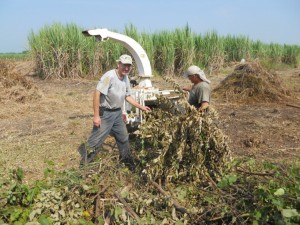
Cleo and Ervin running chipper as we clear out the last of the land in preparation for getting it all into crop.

This division of leadership is new for us and we need your prayers as we begin to function in this new direction. The Mexican culture in general, as well as the Mexican church culture tends to be top heavy in leadership control. We desire to walk free from this as God allows. Please remember us through these changing roles that we are each taking on.

This blog is becoming long, and I don’t want to overburden you at this time. However, one thing that has been clear to Javier and me over the past months, and which became exceedingly clear during our meetings, is the need for a simple house to be built on the landsite immediately. Until the land has a building on it and a “presence” living there, and until we fence it and “privatize” it in this way, it can never be respected as a viable private space. There are other compelling reasons as well. First of all, we need a safe place to put the tractor and other farm implements that God has blessed us with. Then, as alluded to above, until we have a couple living on the farm and taking care of it, it really doesn’t mater what crops we grow (besides sugarcane) as we won’t benefit from the harvest because it will disappear before we will get it. But, really, the biggest need is for housing so that we can begin the Training/Discipleship Center. We need housing for a couple who will look after the farm, but also who will be the mentors and spiritual parents for the trainees. It is impossible to have any students at this point because we have no place to put them.

Because of this immediate and pressing need I promised that I will try to raise funds to build a basic house on the farm which will house a training couple as well as several student trainees. Our needs at this point are basic, but construction costs in Mexico are no longer cheap. I think that realistically we will need somewhere around the $35,000 dollar mark to build and finish to a point that we can use the facilities as a training center.

Although this Training Center will include classroom-based Bible teaching, it will not have a strictly academic focus.

Clearing the final area of land - a three quarter hectare area of trees and weeds. Beyond the end of the sugarcane is the area that we have just finished clearing and cultivating - in fruit trees.

Rather it will be a training center where men and women can come to be trained in the Bible (in a classroom setting), where they will do physical work on the farm, where they will learn how to raise their own food and become self-financing to a large extent, where they will learn to develop a missionary heart by ministering in the surrounding villages, where they will be mentored and discipled both physically and spiritually, and have spiritual fathers who will live and work beside them on a daily basis.

Based on a hands-on model, this Training Center will be a place where trainees will be discipled in both spiritual and practical skills. Daily activities will include work on the sugarcane (the bread and butter of the self financing of the Training Center), as well as developing the orchard (over sixty trees of which are already planted), and working in the gardens which will be growing the food for the table of the Center itself as well as for sale in the market. It may include the making and preserving of marmalades and other preserves from the fruit produced on the land. It may include the building of housing for the Center. It may include the digging of fence posts and building fences. It may include digging a well, etc.

In the afternoons the students will go out to learn to minister. This may include many sorts of ministry from children’s work, teaching classes in the villages (possibly health and hygiene classes, agricultural classes, how to live healthy lives free from addictions and violence), and many other sorts of training classes in the surrounding villages. Trainees can physically help the poor, widows, and orphans in the surrounding area by helping to repair houses, clean land, carry wood, and other physical needs evidenced, etc., (the sky and imagination is the only limits on what can be done). Each of these can be done with a spiritual focus, but will all be able to satisfy the Mexican non-profit demands for a civil association (the legal cover for the Center).

The cane you see behind us is our own crop - praise the Lord for miracles of blessing. We are posing with tools in hand after a day of land and brush clearing.

Later, after regrouping in the early evening, specific ministry can be done in cell groups and house churches in the surrounding villages. A film ministry can be developed in the local communities, etc. The student trainees can learn to minister with, and alongside their mentors.

This is the vision, but none of this can happen until we are able to build someplace to house a host couple and at least several student trainees.

Because of some technical details of Canadian non-profit law any Canadian giving specifically for the purpose of building this specific house on the farm cannot be tax receipted through Listowel Community Church at this point. Of course, if you feel God’s tug on your heart to give towards this particular project (as a Canadian), you can freely give without requiring an income tax receipt. There is no limit on what you can give. At this point though, because of some technicalities, VitW Ministries (Canada) cannot give tax receipts for this particular building project. If Canadians feel led to give for this need, please let Listowel Church know that the money is for building a house on the Training Center land, and that you do not want a tax receipt.

In the States, however, these laws do not apply, and any giving for the ministry can be tax receipted through NewSong Church in Grove, Oklahoma.

I will close now. You will be hearing about this need again I am sure. In fact, we are praying to see if Theresa and I need to hit the road and spend some time visiting churches across the States in order to raise the funds needed so that we can complete this task that God has put into our hands.

If you have any questions please feel free to contact me either by phone at: (702) 516-1478 or by e-mail at my personal address at: steve_frey_74@yahoo.com or at the ministry e-mail address: steven@vitwministries.com.

Blessings,

Steven and Theresa


Posted in VitW Blog | No Comments »


« Older Entries
Newer Entries »


Meet the Missionaries
VITW Blog
Ways to Help VITW
Our Statement of Faith


Designed and built by Jason Funk Design, 2010. Encouraging simplicity.