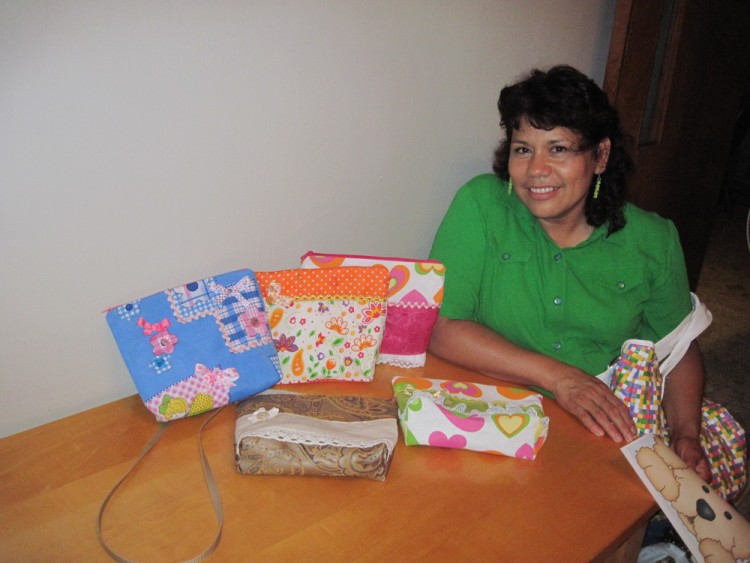
A proud student with makeup bags that she designed, made, and is selling
Well, I am going to tackle a subject that I know nothing about, and would be much wiser to allow the expert to do the writing. However, since it is 11:00 pm, and Theresa is going to bed (being much less a night owl than I am), I will see what I can come up with.
The sewing classes which Theresa began in our living room back in the fall of 2012 have matured into a full sewing and tailoring school which has now moved into the Bible Institute building. The size of the school has stabilized at about five faithful students. Those who came on a whim soon realized that there was a cost involved – both a nominal financial cost, but certainly a time commitment as well. Very soon those who were not willing to pay the price found other things to do instead.
As I have alluded to in some of my blogs over the past years, I am taking a sharp turn away from the “give away” mentality that has too often prevailed in missions, and of which I have certainly also been guilty as well. Time after time it has proven true to me that when we simply give willy-nilly in fashion, not demanding a cost of some sort on the part of the receiver, the gift is perceived to have little, or no value. The niggler of course, is when the very barest minimum in financial cost is more than many can afford.
For example, with the sewing school; in order that the students esteem the training as
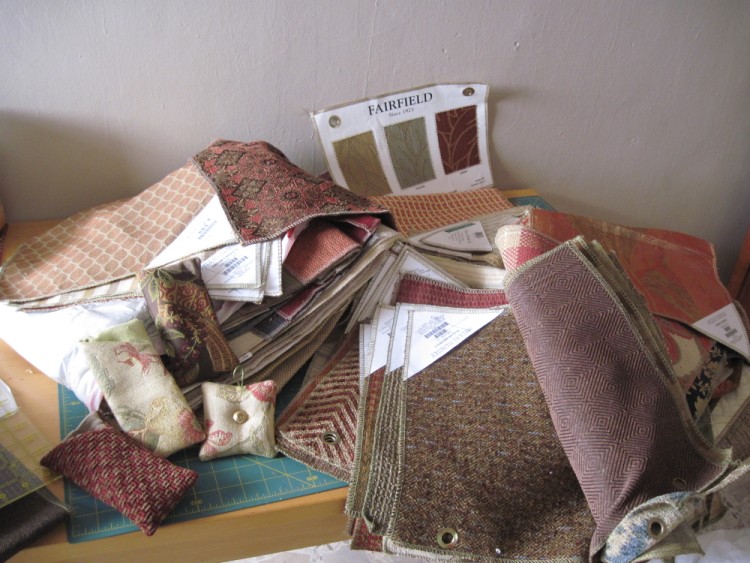
Donated upholstery fabric pieces - the lifeblood of the sewing classes. Theresa has been blessed on several occasions to receive bags of free samples
valuable, Theresa has placed a cost of $25 pesos per month for each student. This equates to $2.08 dollars – not very much – barely enough to cover the replacement of broken needles, thread, and other consumable supplies. However, each student must also come to the school. For most this demands bus fare to and from the classes. For some this is an economic burden that bites into their household finances to a point that it becomes a difficulty.
Still, to simply devalue the gift to a point where it becomes valueless is also not the answer. So, what is should one do?
The tack that we have taken is to place a cost onto the school – minimal, but still a cost nonetheless. Theresa has also been quick to train a national assistant and to hand as much of the ongoing training to her as she is able to handle. When material has been donated to Theresa for the sewing school she has given it to the students free of charge. However, when they began to sew clothing and other things that demanded cloth that was not donated, they needed to purchase their own.
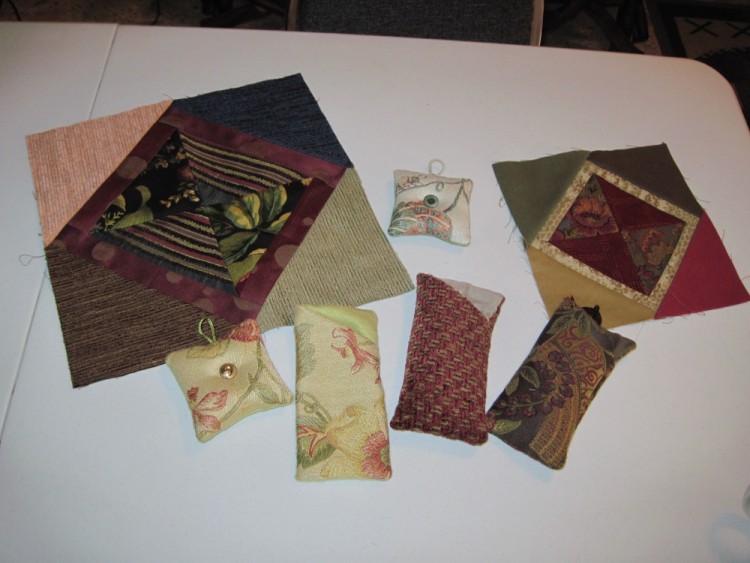
Some beginner class project samples
And it has been working. Cristina, Theresa’s assistant, is now at a point where she is able to take over the school while Theresa is gone. Although she cannot advance the students into higher levels of work because she herself is not there, she is able to maintain the school. The women are doing extremely will – all of them having advanced from no sewing on an electric machine ever, to being very competent now in their work.
Many of the women now take on orders from within the community and earn extra income through their sewing. This has always been Theresa’s goal – that the women will be able to use their newly learned skills to develop cottage industries through which they will be able to help to supplement their family income.
What a blessing this has become for these women.
The next step is to bring this class of women to a point of competence and confidence in
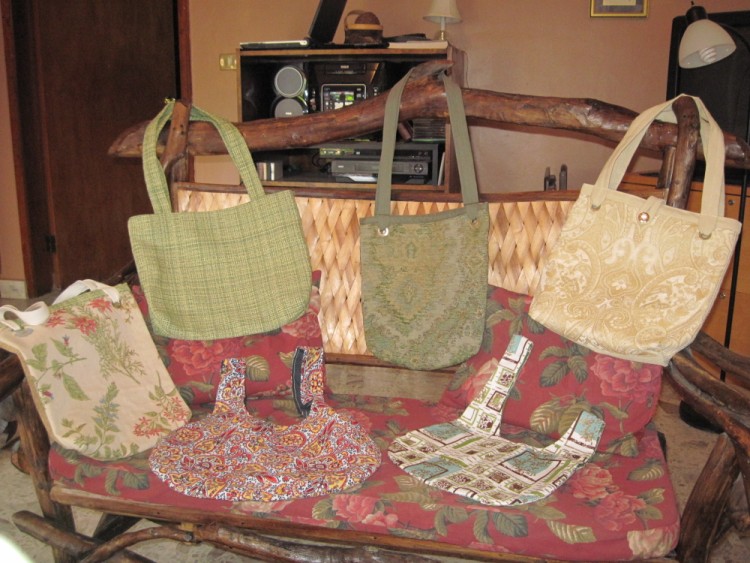
Some more class samples - once again, from free upholstery samples
their work that they can actually begin to make a full-time income through their sewing. Then, or perhaps simultaneously, Theresa will begin teaching other women at beginner levels on a different day. She has developed a 15-level syllabus for the school. At this point none of the women have yet reached the highest level, and have not yet been ready to graduate. But, it is going well, and very soon some will be ready to do so.
I will attach the syllabus below for those of you who know more about sewing than I do. Each student will make one or more of the project ideas listed in each level. Often the women make several samples of each item to improve their skills.
1st Level Project Ideas: Designed to build confidence in beginner sewers. Items are square/rectangular in shape and may include hand sewing, stuffing and lining.
*Read through instructions in manual on using the sewing machine.
*Practice stitching. Use paper sewing sheets and scraps of fabric.
*Square pin cushion with a button center. Cushion could also be used as a Christmas ornament.
*Sunglass or eyeglass case
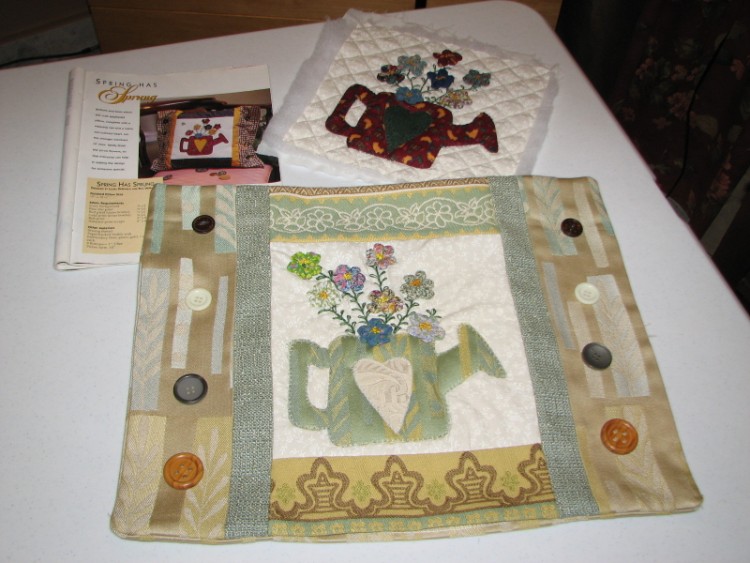
2nd Level Project Ideas: Items that are rectangle in shape may include lining, pockets, tabs, magnetic snaps and hems.
*Basic shoulder bag/purse
*Boot shapers
*Plastic bag holder for the kitchen
*Pillowcase
3rd Level Project Ideas: Items that require rotary cutting, backing, layout design and machine quilting techniques.
*Crazy patch pillow
*10-minute table runner
4th Level Project Ideas: Items that build on previous class projects and include more complicated construction.
*Designer purse with hourglass block, crazy patch blocks or scrap blocks, hand embroidery, pockets, lining and magnetic snap.
*Owl or animal girls’ purse. These require curved sewing, optional hand embroidery, pockets, lining and hand-sewn snap.
5th Level Project Ideas: Items that teach how to insert a straight zipper and simple
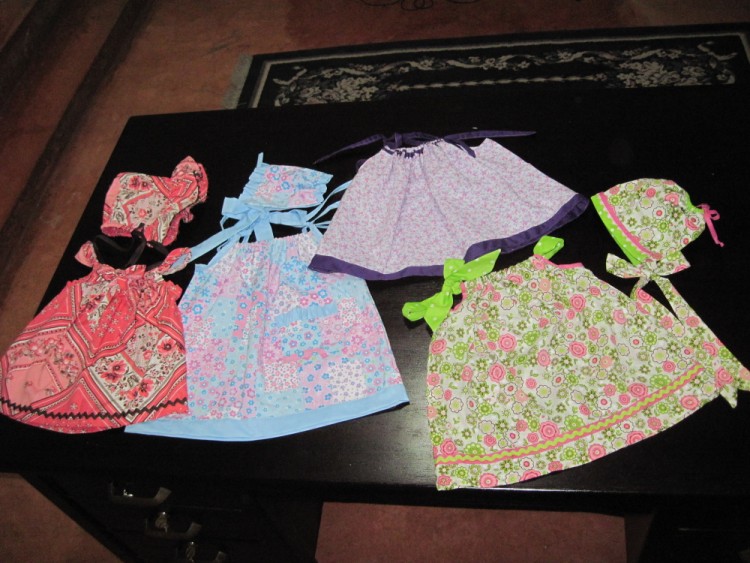
little girl pillow case dresses
appliqué.
*Felt coin purse/pencil case with different appliqué designs
*Cosmetic bag with lining. This is a more complicated project and must be taught after the student has completed one or more ‘felt coin purses’.
6th Level Project Ideas: These items require sewing the student to be able to insert zippers into a curved purse or make-up case.
*Coin purse in two sizes with lining
*Make up bag or camera case with lining
7th Level Project Ideas: Table runners that require accurate rotary cutting, consistent straight seams and exact piecing techniques.
*Table runner with hourglass blocks, batting and backing and machine quilting.
*Table runner with diagonal piecing, batting and backing and machine quilting.
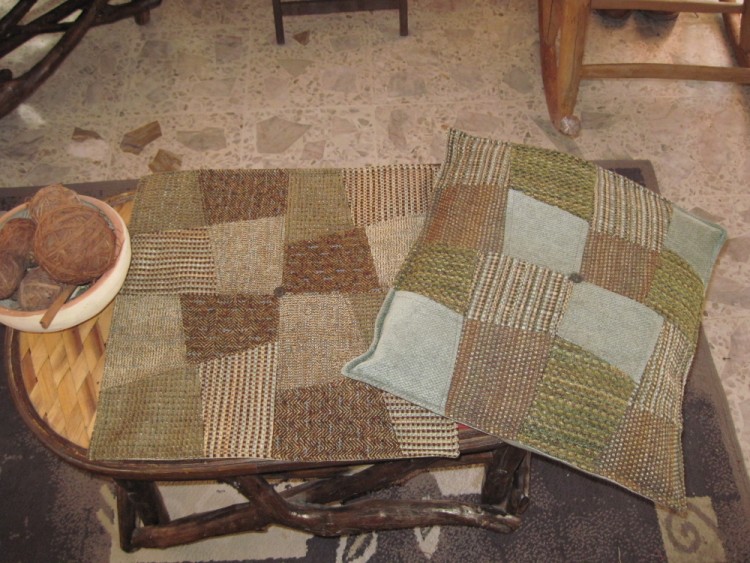
8th Level Project Ideas: Beginner clothing construction items that may include pockets, straps, rickrack, lace and elastic.
*Basic apron
*Lace blouse insert
9th Level Project Ideas: Instructions on measuring the body to create individual custom patterns. Demonstrate basic layout and cutting pattern pieces on the fabric. Review sewing terms, straight of the grain, inserting darts, zipper and/or buttons and buttonholes.
*Women’s wrap skirt in two lengths
*Women’s straight skirt with waistband, darts and zipper on the side or in the back.
Students should cut and sew at least two different styled skirts before moving on to sewing blouses.
10th Level Project Ideas: Measuring for an accurate blouse fit. Blouses include buttonholes, facing, curved piecing and set in sleeves.
*Women’s blouse
11th Level Project Ideas: Beginner projects with knit fabrics.
*Children’s shorts, t-shirt and/or sweatpants and sweatshirt
12th Level Project Ideas: Dresses include buttonholes or zippers, facing or bodice
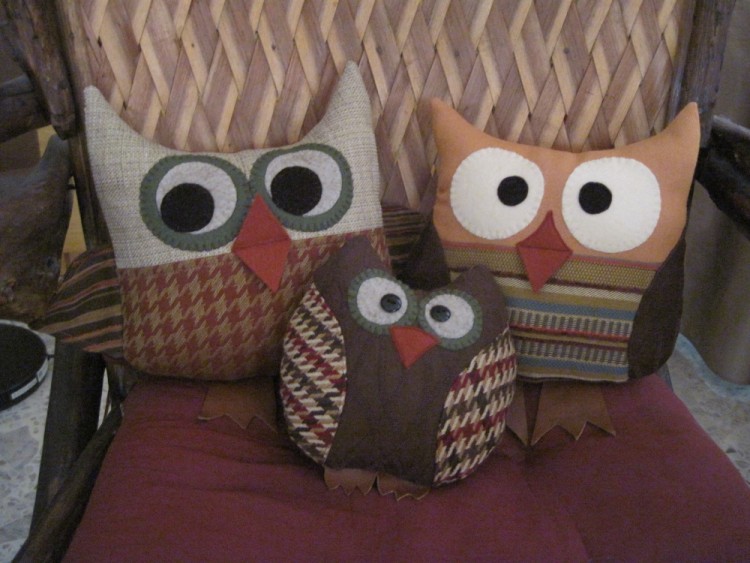
Whoo whoo to you too
lining, gathered sleeves, and curved piecing with optional smocking.
*Girl’s dress basic design
*Girl’s heirloom dress with hand smocking front design
13th Level Project Ideas: Builds on previous classes. Introduction to more complicated clothing designs.
*Women’s basic dress
*Women’s fitted dress with darts, zipper, lined bodice and optional sleeves
*Women’s jacket/blazer with lining, sleeves, collar and pockets
14th Level Project Ideas: Items include basic tailoring.
*Youth school uniforms – pleated skirts, shorts or pants, blouse or shirt and a blazer.
15th Level Project Ideas: Class on precise cutting, ¼ “ seams and quilting.
*Baby quilt or lap size quilt
Christmas Project Ideas: Projects made with students in Cd. Valles during the month of December 2012.
*Felt cone Christmas trees for their tables – practice curved piecing with felt.
*Large snowman face to hang on their door – hand embroidery, curved piecing and machine appliqué.
*Reindeer star to hang on their doorknob – machine appliqué and embroidery.
*Christmas pillow for their sofa – Reindeer or Snowman designs.
*Felt Christmas ornaments: owls, peppermint candies, poinsettias or trees.
I recall a blog that I wrote back on February 28th of last year that I entitled “What Does a Missionary Look Like?” (if you don’t remember it, look it up). For Theresa, at this point in her life, this is what this particular missionary looks like.
Thank you for your love and support of the ministry. Theresa and I will be heading out tomorrow morning on our way to Canada where we will spend some time with family. On the way north we will be meeting with several pastors and churches in order to present the vision and work here in Cd. Valles, as well as the needs that the ministry is facing. We appreciate your prayers as we go.
Blessings,
Steven and Theresa