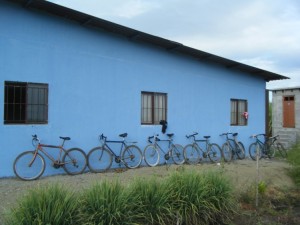
The work crew has arrived
I think that it is definitely time for another blog lest you think that Theresa and I are still stuck in Jimenez, Tamualipas with a broken down van, or have fallen off the map somewhere. We did get the motor rebuilt, everything up and running, and even arrived in Nebraska in time for Theresa’s deadline. So, all ended well on that little adventure.
Theresa and I arrived back at the Texas/Mexico border on the 30th of August where we were able to take care of some business and ministry items before heading across the line for points further south. We dropped by Jimenez again on our trip back to Cd. Valles and spent two nights with our new friends there. On Sunday morning we attended the church service in the little community of Esperanza with pastora Anna and her extended family. It is in this little dusty village where they faithfully minister. After the service we took Sara, one of the sisters of Anna to Rancho Louisiana, a children’s home where she serves, about an hour away from her place in Jimenez.
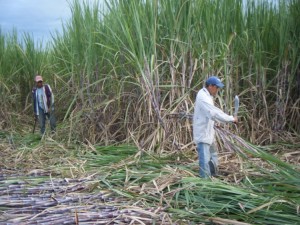
Cutting the seed cane for planting
We spent a delightful afternoon and evening with Ollie Lovett, the founder of the work, and were graciously hosted by her sister and her husband Merrell and Terry Long. It was a delight to see the beautiful, well cared for children at the children’s home as well as attend the church service in the afternoon with them where a group wedding took place with ten couples taking the step of having a church wedding. All of these had been married in a “civil” ceremony at some point in the past, many of them having been together for many years, raised children, and some of which even had grand children. However, they now wished to perform their vows in a Christian church ceremony.
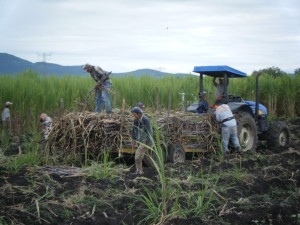
The planting begins
After the vows and Mexican pageantry of the mass wedding ceremony complete with the lazo (lasso), the arras (the decorated box containing thirteen gold colored coins), the pillows, the presentation of Bibles, etc., the service was ended with a baby dedication – all in a good Sunday afternoon service I would say. Then everyone was invited to the back of the building for a fiesta of tacos, flautas, and wedding cake.
On Monday morning we learned to know and appreciate our hosts better over a good Southern U.S.-styled breakfast (hence the name Rancho Louisiana), and were blessed and sent on our way to Cd. Valles with the promise that they would look us up when they happen to be our way.
We arrived in Cd. Valles on Monday evening (September 8th), hitting the ground hard, and have hardly had a chance to breath since.
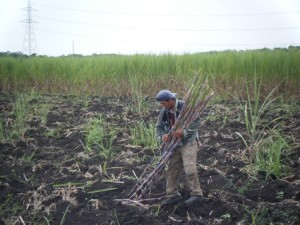
Seed cane is laid into the furrows
What plopped hard and heavy on my plate the second that we arrived was the replanting of the two hectares of sugarcane field that we had cultivated earlier in the summer. Since the original planting had been very badly done three years ago, and since the sugarcane had come in very poorly, we had decided to disc it all under this year and start again fresh after we had had a chance to kill the grass and weeds that we have been fighting with for the past three years.
We had grown our own seed cane and arranged for a crew to come in and do the actual planting. This was accomplished during the latter part of our first week back, and the final seed cane was placed into the furrows late on Saturday evening. We also had a group of guys arrive on Saturday morning – Iván, one of the young men on the Board of Directors, and a couple of his friends – with a load of fertilizer and sugarcane compost that we deposited into the furrows. After a grueling, backbreaking day of labor we finished this part of the planting as well. On Saturday night everything looked great!
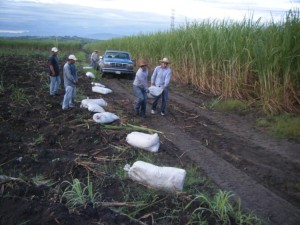
Bags of compost and fertilizer being laid out for dispersing
Since it had gotten too late on Saturday night to cover over the furrows of freshly planted seed cane, the tractor was to return first thing on Sunday morning in order to cover them. When that was finished we would be ready first thing on Monday morning to strap on the sprayer backpacks and spray the field with herbicide in order to finish the on-going battle with the invasive weeds and grasses. A good day or two of spraying and the job should be done. At that point we could sit back and watch the sugarcane grow – how sweet life is!
Uh-huh! Guess again.
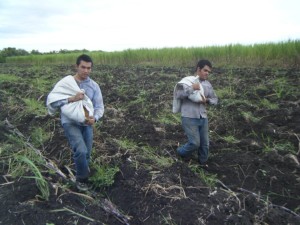
Fertilizer being carefully metered out
Somewhere during the night on Saturday the skies opened and the rains began. I think that there were colliding hurricanes from both the Pacific and the Gulf or something, but the details really don’t matter too much. What does matter is that we have now had almost non-ending rains since that fateful Saturday night on the 13th.
The tension of farming in this type of tropical climate is trying to find adequate rainfall for planting, as compared to the extreme heat and drought conditions that exist during the dry season. Even sugarcane, a relatively forgiving crop suited for the hot conditions that we have, does require adequate water. Combine that with the fact that sugarcane requires hot soil and cannot germinate or grow in cool conditions, and you have a balance act. So, the optimum time is usually over the hot rainy season of later summer and fall.
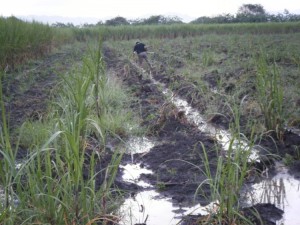
The field as of this morning
Last year, if you will remember, we faced the same dilemma – a washout after our planting in which we lost everything and had to start all over again. This year we had a repeat – at least of the first part. We trust and pray that we won’t have a recurrence of the second part of the scenario.
On Friday of last week we were finally able to get a horse-drawn plow into the field to begin covering over some of the furrows which were not waterlogged. We followed with large hoes to finish the covering.
But the rains would not quit. On Saturday we had to give up with the horse, and we slogged backbreakingly along with the hoes alone, fighting against time, rain, and muck. Soon the seed cane would begin shooting and it would be impossible to spray it with herbicide. It needed to be covered, and no shoots could be exposed.
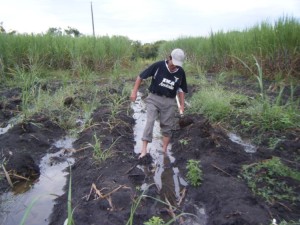
Each cane stock now has to be stomped down and covered over with muck
On Sunday we had a deluge all day, and what had been impossibly wet conditions were now complete rivers running through the field, washing away all of our seed cane into gullies.
On Monday morning we went back to assess at the damage. The whole field was a disaster zone. Furrows were rivulets with snarled-up piles of seed cane lying exposed around the lower areas of the field. But we now were running out of time completely, we needed to get the field back in shape and the seed covered – SOON! However, we could do nothing on Monday since one could not even walk in the field.
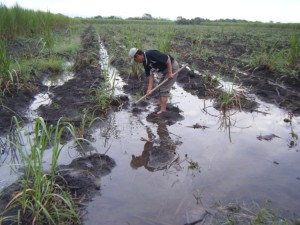
How farming is done in the real world
Yesterday and today (Tuesday and Wednesday) we rolled up our pant legs, took off our boots, picked up hoes and began working barefooted in the muck re-laying seed cane into the furrows and stomping down the muck around them. It has been slow, tedious, and backbreaking work and I can hardly straighten up at the end of the day, but we hope to finish tomorrow.
Today we finally have gone 24 hours without rain. The Lord willing we will not have any more for several weeks so that things can finally dry out.
That, my friend, is why I don’t play the lottery!
So, that has been the mundane and labor intensive part of what has been going on since we arrived back in Mexico. There have also been very encouraging things taking place, and God is bringing together something big. But I am falling asleep at the keyboard, and the rest will have to wait until the next blog.
We covet your prayers and thank you for your friendship and ongoing love.
With all of our hearts,
Steven and Theresa